
Air Bag Trainer
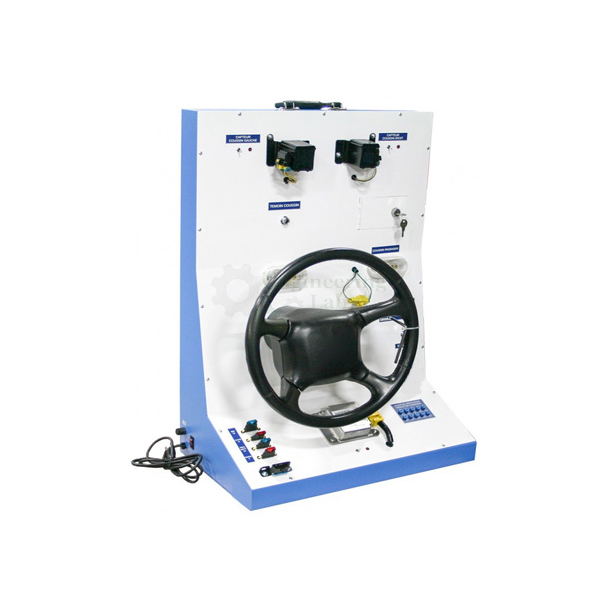
Product Code : EL-AELE-10717
Air Bag Trainer (code EL-AELE-10717) is a classroom trainer, built with OEM components, for teaching how the air bag (supplemental restraint) systems of current vehicles work and how they are diagnosed. It operates like the original vehicle system except that a light takes the place of the exploding air bag, and it has a built-in lockable fault box with 10 faults, an SRS breakout box with test points, a diagnosis socket and an aluminium bench of approx. 1200 × 800 × 1400 mm.
Get a quote: use the Add To Cart enquiry button below, or send your quantity and delivery location through the contact page.
Specifications
| Parameter | Detail |
|---|---|
| Use | Teaching the fundamentals of the air bag systems used in current vehicles |
| Components | OEM components |
| Air bag system | Real, operable air bag system used to show the structure of the system |
| Deployment | A light is used instead of the exploding air bag; instrumentation demonstrates air bag deployment |
| Crash simulation | Small vehicles are made to collide, simulating a traffic accident, and the right and left simulated air bags then inflate |
| SRS demonstration | Complete SRS (supplemental restraint system) function shown in a classroom |
| Steering wheel | Can be removed and refitted during diagnosis or system testing |
| Fault box | Built-in lockable manual fault box for the SRS control module, with 10 faults |
| Breakout box | Integrated SRS breakout box with test points for all terminals, sized for standard meter leads |
| Diagnosis socket | Connects to an automobile decoder to read and clear air bag system fault codes |
| Diagnostic practice | Recognising main components, studying operation settings and using a diagnostic scan tool |
| Training bench | Aluminium |
| Panel | Plastic plate with colour circuit diagram and working principle diagram painted on the surface |
| Power supply | 220 V AC, changed to 12 V DC by the internal circuit; no accumulators or charging needed |
| Short-circuit protection | 12 V DC operation protects the training panel against short circuit |
| Dimensions | Approx. 1200 × 800 × 1400 mm (L × W × H) |
| Weight | Approx. 85 kg |
| Product code | EL-AELE-10717 |
| Manufacturer | Engineering Lab Equipment, Ambala, Haryana, India |
What Is the Air Bag Trainer Used For?
In a vehicle the supplemental restraint system uses crash sensors and a control module to fire the air bags within a fraction of a second of a severe impact, cushioning the occupants against the steering wheel and dashboard. Because a light stands in for the exploding bag, the instructor can trigger the sequence repeatedly, using the small crash vehicles and watching the right and left simulated bags respond. Students then connect a decoder to the diagnosis socket to read and clear codes, probe terminals at the breakout box with ordinary meter leads, and trace the faults the instructor has set in the lockable fault box.
What to Specify When Ordering
- Quantity — how many air bag trainers are needed.
Frequently Asked Questions
Can the deployment be shown more than once in a lesson?
Yes. The trainer functions like the original vehicle system, but a light is used in place of the exploding air bag, so no air bag is fired when the deployment sequence is shown.
How many faults can the instructor set?
The manual fault box for the SRS control module holds 10 faults. It is built into the trainer and lockable, so the fault settings stay under the instructor's control.
How are fault codes read and cleared?
The training panel has a diagnosis socket that connects to an automobile decoder, which reads the fault codes stored by the air bag system and clears them.
What power supply does it use?
It connects to a 220 V AC supply, which the internal circuit changes to 12 V DC, so no accumulators or charging are required; the 12 V DC operation also protects the panel against short circuit.
What is shown on the panel surface?
A colour circuit diagram and a working principle diagram are painted on the plastic plate beside the real components, and the integrated breakout box gives test points for every terminal.
How big and heavy is it?
The aluminium training bench measures approximately 1200 × 800 × 1400 mm and weighs about 85 kg.
OEM Manufacturer
Engineering Lab Equipment (Engineering Labs Equipment Pvt Ltd) builds the Air Bag Trainer at its works in Saha, District Ambala, Haryana (Plot No. 43, Industrial Park, Sector 2, Growth Center). Its automobile engineering cut-section models, working models and trainers go to engineering colleges, polytechnics, technical training institutes and research laboratories in India and abroad, and equipment can be made to an institution's own requirements. For tenders and OEM supply, see the Tenders/OEM page.
Related Automobile Engineering Equipment
- Working Model of ABS Braking System — castored 4-channel ABS rig with disc and drum brakes, per-wheel gauges, breakout box and 6-fault box.
- Power Door Lock System Trainer — plastic-board central locking trainer with 2 OEM actuators, relay, 4-fault box and 21 jumper leads.
- Power Window System Trainer — four-door electric window rig with 4 OEM motors, master and slave switches and a 4-fault box.
- Lighting Training Board Simulator — mobile vehicle lighting system board with motorised headlight beam levelling, jumper wiring diagram and OBD diagnosis.
See the full Automobile Engineering Lab Equipment range or all Mechanical Engineering Lab Equipment.
Request a Quote
For this and other automobile engineering lab equipment, schools and colleges can contact Engineering Lab Equipment, a manufacturer, supplier and exporter based in Ambala, India. For a price, send the number of air bag trainers needed and the delivery location through the contact page; the Add To Cart button on this page also adds the Air Bag Trainer to an enquiry.
Last updated: October 2026


