
Ultrasonic Pulse Velocity Tester
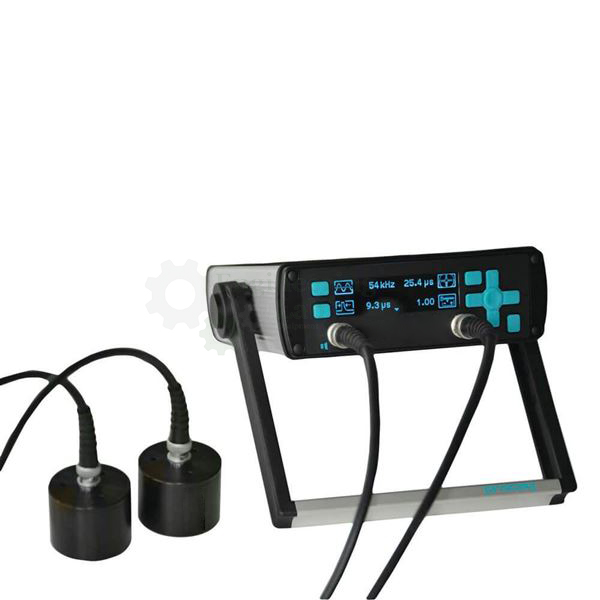
Product Code : EL-CTLE-10326
Ultrasonic Pulse Velocity Tester (code EL-CTLE-10326) is a non-destructive instrument that sends an ultrasonic pulse through concrete and times its passage, so that the elastic properties and strength of the material can be assessed. It uses 52 kHz transmit and receive transducers suited to concrete, wood, stone and plastic, and its readings are used to examine uniformity, cavities, cracks, fire or frost damage, delamination and deterioration.
Get a quote: use the Add To Cart enquiry button below, or send your quantity and delivery location through the contact page.
Specifications
| Parameter | Detail |
|---|---|
| Use | Non-destructive evaluation of the elastic properties and strength of concrete |
| Measuring principle | Transit time of an ultrasonic wave travelling from the transmit transducer to the receive transducer through the material |
| Excitation | High voltage applied to the transmit transducer to generate the ultrasonic wave |
| Transducers | 52 kHz concrete transducers, transmit and receive |
| Suitable materials | Highly attenuative materials, including concrete, wood, stone and plastic |
| Investigations | Uniformity, cavities, cracks, fire/frost damage, delamination, deterioration and strength |
| Product code | EL-CTLE-10326 |
| Manufacturer | Engineering Lab Equipment, Ambala, Haryana, India |
What Is the Ultrasonic Pulse Velocity Tester Used For?
Sound travels faster through dense, stiff concrete than through weak, cracked or honeycombed material, so the time a pulse takes to cross a member reveals its condition. The operator places the transmit and receive transducers on opposite or adjacent faces, with a coupling medium for good contact, and the tester excites the transmitter with a high voltage and measures the transit time to the receiver. Dividing the path length by the transit time gives the pulse velocity, and comparing values over a grid of points maps uniformity, internal cavities, cracks, fire or frost damage and delamination.
What to Specify When Ordering
- Quantity — the number of testers required.
Frequently Asked Questions
How does the tester judge the quality of concrete?
It measures the transit time of an ultrasonic wave between two transducers. Stronger concrete with higher elastic properties gives a shorter transit time, while weaker or damaged concrete slows the wave.
What transducer frequency is used?
The tester uses 52 kHz concrete transducers, which are designed to send and receive the ultrasonic signal through highly attenuative materials.
Can it test materials other than concrete?
Yes. The 52 kHz transducers are made to work in highly attenuative materials, and wood, stone and plastic are named along with concrete.
What defects can it help to locate?
Readings are used to investigate uniformity, cavities, cracks, fire and frost damage, delamination and general deterioration, as well as to give an estimate of strength.
Why is the test called non-destructive?
The pulse passes through the concrete without marking or loading it, so a structure can be examined at many points and retested later without any damage.
What details should an overseas buyer send?
An export enquiry should list the number of testers, the destination country and port or city, the delivery terms such as FOB or CIF, packing needs and any tender reference.
OEM Manufacturer
The Ultrasonic Pulse Velocity Tester is made by Engineering Lab Equipment (Engineering Labs Equipment Pvt Ltd) at its works at Plot No. 43, Industrial Park, Sector 2, Growth Center, Saha, District Ambala, Haryana, India. The company designs, makes and tests concrete testing equipment, from workability apparatus and specimen moulds to compression and flexure machines for engineering colleges, polytechnics, technical training institutes and research laboratories in India and overseas, and can build equipment to an institution's own requirements. Tender and OEM enquiries are handled through the Tenders/OEM page.
Related Concrete Testing Equipment
- Test Sieves — stainless steel sieves with polished 22 ga. die-stamped frames and smooth, rivet-free sieving surface.
- Mortar Penetrometer — spring penetrometer graduated 0–70 kg with 6 needles for the hardening rate of sieved mortar.
- Compression Testing Machine (Channel Type Load Frame) — motorised C channel compression tester with 20 cm gauge, slow/fast regulator and 50–3000 kN ranges.
- Double Beam Screed — 4200 mm iron vibrating screed with 2 bars and 1 H.P. vibratory motor for slabs.
See the full Concrete Testing Lab Equipment range or all Civil Engineering Lab Equipment.
Request a Quote
For this and other concrete testing lab equipment, schools and colleges can contact Engineering Lab Equipment, a manufacturer, supplier and exporter based in Ambala, India. To ask for a quotation, send the number of ultrasonic testers required and your delivery location through the contact page, or use the Add To Cart enquiry button on this page.
Last updated: October 2026


