
Computerized Cam Analysis
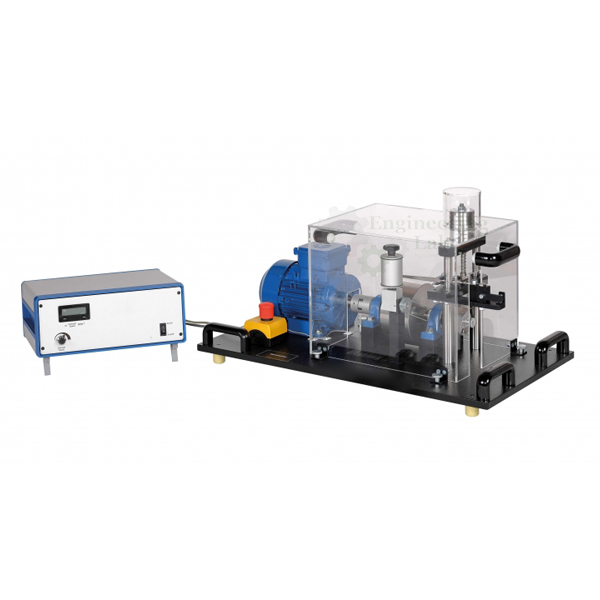
Product Code : EL-DOMLE-10769
Quick Answer:
Computerized Cam Analysis is a demonstration unit for the dynamic investigation of a cam mechanism at various speeds, using four interchangeable cam members (a tangent cam, a hollow cam and two circular-arm cams with different head radius) paired with two engaging-member types (a flat receiver with plunger or a rolling receiver with plunger) to compare their motion behaviour. A speed-controlled drive motor with a large flywheel holds the speed as constant as possible while a valve is simulated with a mass and a spring, and a recorder synchronized with the cam member records the actual elevation curve of the mechanism so students can compare it with theory and determine the limit speed for each combination.
The Computerized Cam Analysis unit allows the dynamic investigation of a cam mechanism at various speeds, comparing four typical cams with their corresponding engaging members in terms of motion behaviour; the valve itself is simulated with a mass and a spring. A recorder synchronized with the cam member records the actual elevation curve of the cam mechanism, while a speed-controlled drive motor fitted with a large flywheel generates a speed that is as constant as possible. The open design means the motion is clearly visible in every detail, and a transparent protective cover ensures safe operation. The experimental unit is intended for demonstration in engineering education and is not suitable for use as a test bench in the field of endurance testing or tribology.
FEATURES:
Comparison of the elevation curves of different cam-member shapes
Comparison of elevation curves with theory
Four different cam members, two different engaging members
Influence of spring stiffness and mass on the dynamic behavior
Determine the limit speed and compare with theory
Influence of moving mass on the motion of cam member/plunger
Influence of return-spring stiffness and preload on the motion of cam member/plunger
Record elevation curves of cam mechanisms
SPECIFICATION:
Cam-shaped cam members: tangent cam, hollow cam, 2 circular arm cams with different head radius
2 different engaging members: flat receiver with plunger or rolling receiver with plunger
3 interchangeable return springs and spring preload.
Oscillating mass can be increased with 5 additional weights.
Optical speed sensor
Transparent protective cover for safe operation
Recorder: toothed belt drive
Drive motor :
DC asynchronous motor with frequency converter
Power: 250W
Speed: 60…670min-1
Cam-shaped cam member :
Stroke, each: 15mm
Opening angle, each: 140°
Spring stiffness :
Hard: 5,026N/m
Medium: 2,601N/m
Soft: 613N/m
Masses :
Additional masses supplied with different weights
Power required for operation :
230V, 50Hz, 1 phase
230V, 60Hz, 1 phase; 120V, 60Hz, 1 phase
DIMENSIONS AND WEIGHT:
L x W x H (approx.): 800 x 600 x 500 mm
Weight: 85kg
Contact Engineering Lab Equipment for your School, College Civil and Mechanical Engineering Lab Instruments. We are the best and renowned engineering lab equipments manufacturers, engineering lab equipments manufacturers, physics lab engineering equipment exporter, engineering educational equipment India, engineering lab equipments suppliers, engineering educational equipments supplier in Ambala, India.
Last Updated: September 2026
Related Products: Cam Analysis Apparatus, Scotch Yoko Mechanism, Free and Forced Vibration Apparatus


