Pat Test, Brass Ring Mould
Product Code : EL-CTLE-10342
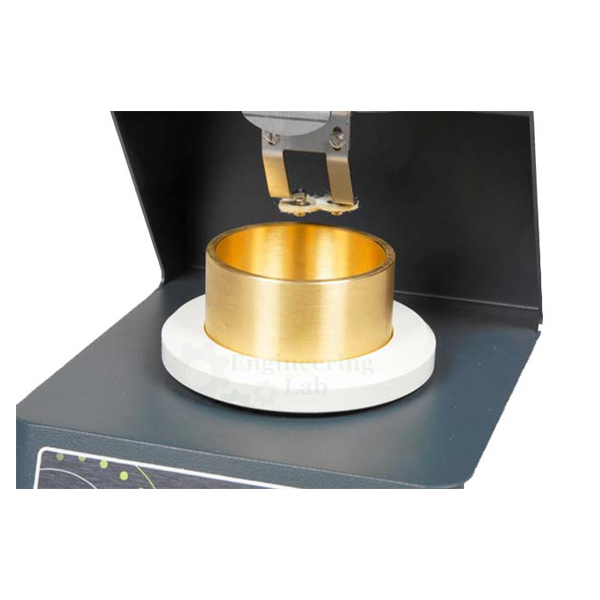
Pat Test, Brass Ring Mould (code EL-CTLE-10342) is a brass ring used to cast pats for the soundness test on hydrated lime and gypsum plasters. The ring is 100 mm in diameter and 5 mm deep with a 5° internal taper, each one comes with a glass plate, and three rings are needed for every test.
Get a quote: use the Add To Cart enquiry button below, or send your quantity and delivery location through the contact page.
Specifications
| Parameter | Detail |
|---|---|
| Use | Determining the soundness of hydrated lime and gypsum plasters |
| Material | Brass |
| Size | 100 mm dia. × 5 mm deep |
| Internal taper | 5° |
| Supplied with | Glass plate |
| Moulds per test | Three |
| Standards | EN 459-2, BS 890, BS 1191 |
| Product code | EL-CTLE-10342 |
| Manufacturer | Engineering Lab Equipment, Ambala, Haryana, India |
What Is the Pat Test, Brass Ring Mould Used For?
In a pat test, lime or plaster is formed into thin pats that are examined for pops, pits, cracks or blisters, signs that coarse or unslaked particles are expanding after the material has set. The operator stands each ring on its glass plate, fills it with the prepared material, strikes the surface level with the top of the ring and leaves the pat to harden under the conditions the test method sets out. The pats are then inspected for these defects. Three moulds are filled for each determination, and the standards listed are EN 459-2, BS 890 and BS 1191.
What to Specify When Ordering
- Quantity — the number of ring moulds required, allowing three for each test.
Frequently Asked Questions
What is the Pat Test, Brass Ring Mould used for?
It casts the pats for the soundness test on hydrated lime and on gypsum plaster, and the hardened pats are then examined for signs of expansion.
What size is the ring?
The brass ring measures 100 mm in diameter and 5 mm in depth, and its inner face has a taper of 5°.
How many rings are needed for one test?
Three moulds are required for each test, and every mould comes complete with its own glass plate on which the pat is cast.
Which standards are listed?
The standards listed for the Pat Test, Brass Ring Mould are EN 459-2, BS 890 and BS 1191.
OEM Manufacturer
Engineering Lab Equipment (Engineering Labs Equipment Pvt Ltd) builds the Pat Test, Brass Ring Mould at its works in Saha, District Ambala, Haryana (Plot No. 43, Industrial Park, Sector 2, Growth Center). Its cement testing equipment such as Vicat and Blaine apparatus, moulds, mixers and curing equipment go to engineering colleges, polytechnics, technical training institutes and research laboratories in India and abroad, and equipment can be made to an institution's own requirements. For tenders and OEM supply, see the Tenders/OEM page.
Related Cement Testing Equipment
- Prism Mould 25x25x280 mm — set of three 25 × 25 × 280 mm prism compartments with contact points for mortar expansion tests.
- Cement Curing Cabinet — polypropylene humidity cabinet at 20±1 °C and 95% to saturation with four stainless steel racks.
- Compression-Flexure Cement Testing Frames — 500 or 600 kN steel compression frame, with optional 15 kN flexural station, for low strength specimens.
- Le Chatelier Flask — 250 ml glass flask with 0–1 ml and 18–24 ml neck graduations for cement specific gravity.
- Water Retention Apparatus — mortar suction set with perforated brass dish, funnel and flask, using an aspirator or vacuum pump.
See the full Cement Testing Lab Equipment range or all Civil Engineering Lab Equipment.
Request a Quote
For this and other cement testing lab equipment, schools and colleges can contact Engineering Lab Equipment, a manufacturer, supplier and exporter based in Ambala, India. For a price, send the number of ring moulds, allowing three for each soundness test and the delivery location through the contact page; the Add To Cart button on this page also adds the Pat Test, Brass Ring Mould to an enquiry.
Last updated: October 2026