Double Beam Screed
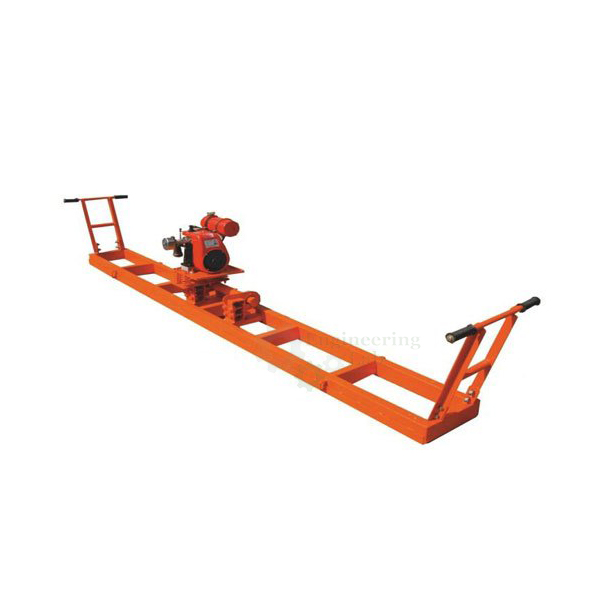
Product Code : EL-CTLE-10932
Double Beam Screed (code EL-CTLE-10932) is an electrically powered vibrating screed used in the construction industry to level concrete slabs and floors. It is made of iron, has a length of 4200 mm and 2 bars, is driven by a vibratory motor with a power rating of 1 H.P., and weighs a minimum of 105 kg.
Get a quote: use the Add To Cart enquiry button below, or send your quantity and delivery location through the contact page.
Specifications
| Parameter | Detail |
|---|---|
| Use | Levelling concrete slabs and floors by vibration |
| Material | Iron |
| Power mode | Electric |
| Length | 4200 mm |
| Number of bars | 2 |
| Prime mover | Vibratory motor |
| Power rating | 1 H.P. |
| Application | Construction machinery |
| Weight | Min. 105 kg |
| Product code | EL-CTLE-10932 |
| Manufacturer | Engineering Lab Equipment, Ambala, Haryana, India |
What Is the Double Beam Screed Used For?
After concrete is placed for a slab or floor it has to be struck off to level and compacted at the surface before finishing. The screed is laid across the side forms with its 2 bars resting on the fresh concrete, and while the vibratory motor runs, the operators draw it slowly along the slab; the vibration consolidates the top layer while the bars strike off surplus concrete to the level of the forms. The 4200 mm length lets a wide strip be screeded in one pass, leaving a level surface ready for floating.
What to Specify When Ordering
- Quantity — the number of screeds required.
Frequently Asked Questions
What is the Double Beam Screed used for?
It is used in the construction industry for levelling concrete slabs and floors, vibrating the freshly placed concrete as it is drawn along the surface.
How long is the screed?
The screed has a length of 4200 mm and 2 bars, so a broad strip of slab can be levelled in each pass.
What drives the vibration?
An electric vibratory motor with a power rating of 1 H.P. acts as the prime mover and vibrates the 2 bars of the screed.
How heavy is it and what is it made of?
The screed is made of iron and weighs a minimum of 105 kg, and it is classed as construction machinery rather than laboratory apparatus.
What should be included in an export enquiry?
List the number of screeds, the destination country and port or city, the delivery terms such as FOB or CIF, packing requirements and any tender reference.
OEM Manufacturer
The Double Beam Screed is made by Engineering Lab Equipment (Engineering Labs Equipment Pvt Ltd) at its works at Plot No. 43, Industrial Park, Sector 2, Growth Center, Saha, District Ambala, Haryana, India. The company designs, makes and tests concrete testing equipment, from workability apparatus and specimen moulds to compression and flexure machines for engineering colleges, polytechnics, technical training institutes and research laboratories in India and overseas, and can build equipment to an institution's own requirements. Tender and OEM enquiries are handled through the Tenders/OEM page.
Related Concrete Testing Equipment
- Compaction Factor Test for Concrete Workability — trowels, 15.2 cm hand scoop, 61 cm rod and balance for the compaction factor test.
- Slump Test Apparatus — slump cone set with 300 mm high cone, clamped base plate and 16 mm graduated steel rod.
- J Ring Apparatus — stainless steel J-Ring set with 900 mm base plate, slump cone and weighted collar for SCC.
- Automatic Digital Compression Testing Machine — 3000 kN automatic compression tester for concrete cubes and cylinders with 256-test memory.
- Initial Surface Absorption Test (ISAT) Apparatus — capillary tube, reservoir and stand set measuring water absorption into concrete at 200 mm head.
See the full Concrete Testing Lab Equipment range or all Civil Engineering Lab Equipment.
Request a Quote
For this and other concrete testing lab equipment, schools and colleges can contact Engineering Lab Equipment, a manufacturer, supplier and exporter based in Ambala, India. To ask for a quotation, send the number of screeds required and your delivery location through the contact page, or use the Add To Cart enquiry button on this page.
Last updated: October 2026