Proctor Moulds and Rammers
Product Code : EL-STLE-10407
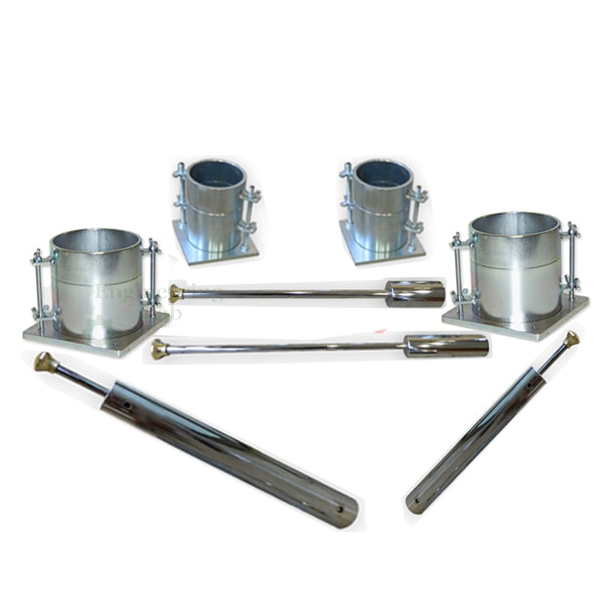
Proctor Moulds and Rammers (code EL-STLE-10407) are compaction moulds and rammers used to determine the relationship between the moisture content and density of compacted soil. Each mould has a collar, mould body and base plate, the rammer has a guide sleeve with vent holes, and every version is of plated steel with the same shape, the diameter and capacity varying slightly.
Get a quote: use the Add To Cart enquiry button below, or send your quantity and delivery location through the contact page.
Specifications
| Parameter | Detail |
|---|---|
| Use | Determining the relationship between moisture content and density of compacted soil |
| Mould parts | Collar, mould body and base plate |
| Rammer | Guide sleeve with vent holes |
| Material | Plated steel |
| Versions | Different versions for the various commonly used standards, identical in shape and differing slightly in diameter and capacity; ASTM/AASHTO versions shown in this section |
| Standards | ASTM D698, D1557, D558; AASHTO T99, T180, T134; EN 12386-2, EN 13286-4; BS 1377:4, BS 1924:2 |
| Product code | EL-STLE-10407 |
| Manufacturer | Engineering Lab Equipment, Ambala, Haryana, India |
What Are the Proctor Moulds and Rammers Used For?
The compaction test finds the moisture content at which a soil reaches its maximum dry density under a set compactive effort, and these values are used to specify and check the compaction of embankments, subgrades and fill. Soil at a known moisture content is compacted in layers in the mould, with the collar fitted, by dropping the rammer through its guide sleeve a set number of times per layer; the collar is then removed, the soil trimmed level and the mould weighed. Repeating this at several moisture contents gives the moisture-density curve, and the specimen can then be pushed out with the Universal specimen extruder.
What to Specify When Ordering
- Quantity — the number of mould and rammer sets required.
- Version — the test standard the mould and rammer are to suit, since diameter and capacity differ slightly between versions.
Frequently Asked Questions
What parts make up the mould and rammer?
The mould consists of a collar, mould body and base plate, and the rammer is built with a guide sleeve that has vent holes.
How do the different versions differ?
All versions are made of plated steel and have the same shape; they differ only slightly in diameter and capacity to suit the various commonly used test methods.
How are specimens removed from the mould?
The compacted specimen can be pushed out of the mould with the Universal specimen extruder once the collar and base plate are taken off.
Which standards are given for the moulds and rammers?
The standards listed are ASTM D698, D1557 and D558; AASHTO T99, T180 and T134; EN 12386-2 and 13286-4; and BS 1377:4 and 1924:2.
OEM Manufacturer
The Proctor Moulds and Rammers are made by Engineering Lab Equipment (Engineering Labs Equipment Pvt Ltd) at its works at Plot No. 43, Industrial Park, Sector 2, Growth Center, Saha, District Ambala, Haryana, India. The company designs, makes and tests soil testing equipment for classification, compaction, density, shear and consolidation tests for engineering colleges, polytechnics, technical training institutes and research laboratories in India and overseas, and can build equipment to an institution's own requirements. Tender and OEM enquiries are handled through the Tenders/OEM page.
Related Soil Testing Equipment
- Automatic Soil Compactor — automatic rammer for standard, modified and CBR compaction with 2.5 or 4.5 kg rammer.
- Standard Compaction Test — standard compaction set with 1000 cc steel mould, collar, base plate and 2.6 kg rammer.
- Vibration Compaction Hammer — variable speed vibrating hammer with aluminium housing, 12-step angle lock and single-step tool holder.
- Soil Extruder, Motor Operated — 60 kN motorised hydraulic extruder for soil sample tubes up to 160 mm, 900 mm stroke.
See the full Soil Testing Lab Equipment range or all Civil Engineering Lab Equipment.
Request a Quote
For this and other soil testing lab equipment, schools and colleges can contact Engineering Lab Equipment, a manufacturer, supplier and exporter based in Ambala, India. To ask for a quotation, send the number of sets and the test standard the moulds and rammers must suit and your delivery location through the contact page, or use the Add To Cart enquiry button on this page.
Last updated: October 2026