
Pulveriser
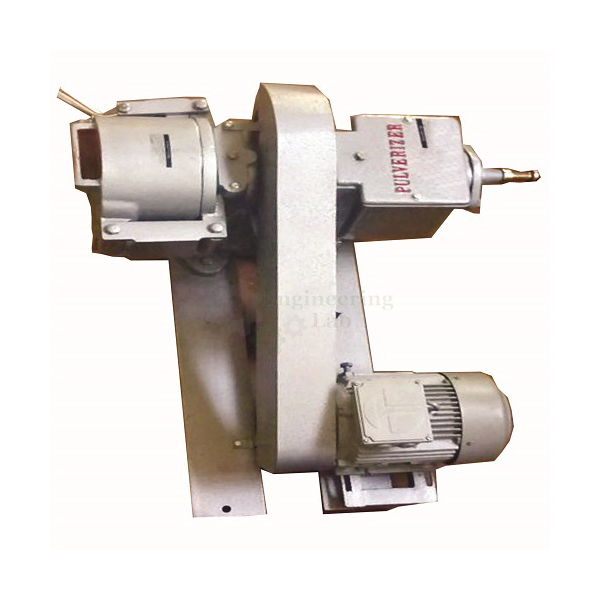
Product Code : EL-ATLE-10956
Pulveriser (code EL-ATLE-10956) is a contained laboratory grinder with a rotating disc, used to reduce aggregate and mineral samples to a fine particle size for laboratory analysis. The 175 mm diameter grinding wheel is High Carbon Steel with a hardness of 53 to 60 HRC and moves with a vertical plane planetary motion; feed material up to 6 mm is accepted, about 450 g of 100 mesh quartz material is reduced in one minute, and the supply is three phase 440 V A.C.
Get a quote: use the Add To Cart enquiry button below, or send your quantity and delivery location through the contact page.
Specifications
| Parameter | Detail |
|---|---|
| Use | Reducing aggregate and mineral samples to a fine particle size for laboratory analysis |
| Type | Contained grinder fitted with a rotating disc |
| Wheel diameter | 175 mm |
| Wheel material | High Carbon Steel |
| Wheel hardness | 53 to 60 HRC |
| Motion | Vertical plane planetary motion |
| Feed size | Up to 6 mm |
| Grinding rate | About 450 g of 100 mesh quartz material in one minute |
| Supply | Three phase, 440 V A.C. |
| Product code | EL-ATLE-10956 |
| Manufacturer | Engineering Lab Equipment, Ambala, Haryana, India |
What Is the Pulveriser Used For?
Before chemical or mineralogical analysis, an aggregate or mineral sample has to be ground to a powder so that the small portion taken for testing represents the whole. The operator loads the crushed sample, no larger than 6 mm, into the grinder and runs it; the disc, moving in a vertical plane planetary motion, grinds the material against the High Carbon Steel wheel until it reaches the fineness required. About 450 g of quartz material can be processed in one minute, and the ground product is collected for sampling and analysis.
What to Specify When Ordering
- Quantity — the number of pulverisers required.
Frequently Asked Questions
What is the Pulveriser used for?
It is a laboratory grinder that reduces aggregate and mineral samples to a fine particle size, ready for laboratory analysis of the ground material.
What is the maximum feed size?
Material up to 6 mm can be fed into the Pulveriser, so coarser samples are first broken down to that size.
How is the grinding done?
A rotating disc moves with a vertical plane planetary motion against a 175 mm grinding wheel, breaking the sample down by grinding action.
How hard is the grinding wheel?
The wheel is made of High Carbon Steel with a hardness of 53 to 60 HRC, measured on the Rockwell C scale.
What output and power supply are given?
It can reduce about 450 g of 100 mesh quartz material in one minute and is suitable for operation on a three phase 440 V A.C. power supply.
OEM Manufacturer
The Pulveriser is made by Engineering Lab Equipment (Engineering Labs Equipment Pvt Ltd) at its works at Plot No. 43, Industrial Park, Sector 2, Growth Center, Saha, District Ambala, Haryana, India. The company designs, makes and tests aggregate testing equipment for grading, strength, abrasion and shape tests for engineering colleges, polytechnics, technical training institutes and research laboratories in India and overseas, and can build equipment to an institution's own requirements. Tender and OEM enquiries are handled through the Tenders/OEM page.
Related Aggregate Testing Equipment
- Pulverizer — self-contained disc grinder with 175 mm high carbon steel wheel, grinding 6 mm feed to 100 mesh.
- Jaw Crusher — laboratory crusher with manganese steel jaws, 3 to 10 mm discharge setting and 440 V three phase drive.
- High Capacity Sieve Shaker — 30 litre shaker for coarse materials taking six 457 × 660 mm screen trays and a dustpan.
- Sample Splitter — cadmium-plated divider for sand and aggregate samples up to 108 mm, with 30 litre clam shell hopper.
See the full Aggregate Testing Lab Equipment range or all Civil Engineering Lab Equipment.
Request a Quote
For this and other aggregate testing lab equipment, schools and colleges can contact Engineering Lab Equipment, a manufacturer, supplier and exporter based in Ambala, India. To ask for a quotation, send the number of pulverisers required and your delivery location through the contact page, or use the Add To Cart enquiry button on this page.
Last updated: October 2026


